Start here
Models are different. That sounds like a silly thing to say. It stops being silly when I notice that they differ the way people differ.
delegate is the machine I built so that the model I pick changes one thing only: how good the code is. This page is the kit at a glance: the problem, the idea, where the kit sits on the ladder that it climbs, the team, and how one ticket moves from the brief to the merge. It is not a tutorial and it is not a reference. It links both at the end. Each term is in bold where it first appears, and it links its entry in the glossary. After that, a dotted underline marks the term: hover for its definition, or follow it to its entry.
This is delegate watch while it follows the work on 11 tickets. The text under the figure is the same frame with no colour.
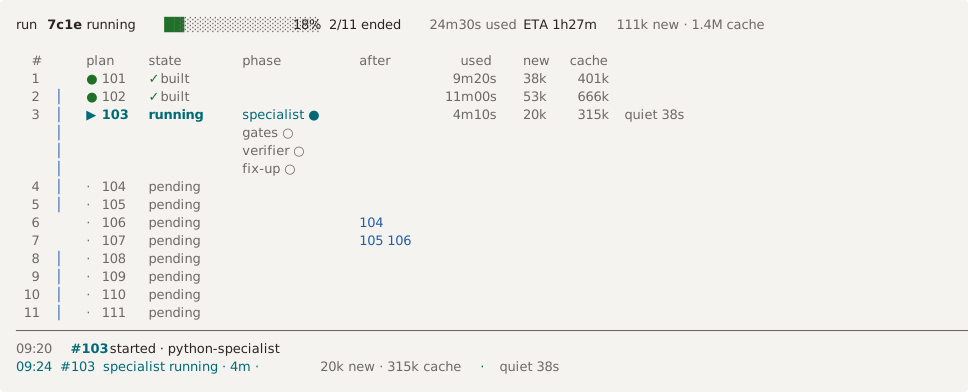
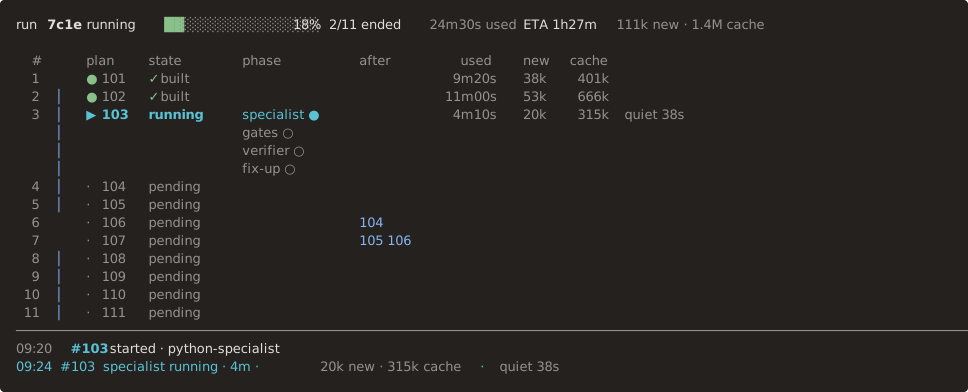
run 7c1e  running  ██░░░░░░░░░░░░░░ 18%  2/11 ended  24m30s used  ETA 1h27m  111k new · 1.4M cache

  #      plan    state       phase          after        used    new   cache
  1      ● 101   ✓ built                                9m20s    38k    401k
  2  │   ● 102   ✓ built                               11m00s    53k    666k
  3  │   ▶ 103   running     specialist ●               4m10s    20k    315k  active 38s ago
     │                       gates ○
     │                       verifier ○
     │                       fix-up ○
  4  │   · 104   pending
  5  │   · 105   pending
  6      · 106   pending                    104
  7      · 107   pending                    105 106
  8  │   · 108   pending
  9  │   · 109   pending
 10  │   · 110   pending
 11  │   · 111   pending
────────────────────────────────────────────────────────────────────────────────────────────────────────────────────────
09:20  #103  started · python-specialist
09:24  #103  specialist running · 4m · 20k new · 315k cache · active 38s ago
The problem
I've worked with Haiku, Sonnet, Opus, Fable, Qwen and OpenAI's models, and each one frustrated me in its own way. I prefer Claude models, because they think and work most like I do. OpenAI's models approached problems differently from how I wanted them to, and they valued different things from what I value. So did the open-weight models.
Bassim Eledath names the cause in one sentence: "These models were post-trained differently and have meaningfully different dispositions." He puts those differences to work, and for exploration they help. For the build of one piece of work, a difference in disposition is noise.
So here's the question I started with. When I put a team of people on a customer problem, I want them to work as one team. How do I get a team of models to do the same? How do I get to the point where the model I pick doesn't matter?
Within the limits of what each model can do, of course. I want to wrap the right context, tools, process, constraints and support around a model, so that the only difference between running Qwen and running Opus is how good the code is. Not how well it reasoned about the task. Not how well it used the tools. Not how well it understood my context. Just the code.
The same model, twice
It started with me in a terminal, driving one agent: write this function, build that feature. That works, but I was the process.
Then I delegated to subagents, and the inconsistency showed. I gave two Opus sessions two similar tickets, each a full vertical slice from the front end to the database. Same model, same kind of work. They planned in different ways, used the tools in different ways (sometimes more successfully, sometimes less), and wrote code that read differently. A short remark early in the conversation, about how I like to write Java or how I like to break down modules, changed the code that came back.
One model couldn't agree with itself. A team of different models had no chance, unless something other than the model held the way of working.
Managing each model in prose
So I wrote the way of working down: a coordinator session that I run, a specialist that builds, and a verifier that checks. Then came rules for each model: a section for one vendor's CLI, a headless profile for another, and a checklist for models below a certain tier. Each section managed a model like a new colleague. It reminded the model of the habit I corrected yesterday and gave it a checklist for the one I expected tomorrow.
The prose helped, but it never held. A rule in prose binds one model and only advises the next one, and how seriously a model takes prose is one more way that models differ.
Playing football
Then there was the review loop. The verifier rejects, and the specialist fixes. The verifier rejects again, and now it passes. Two rounds of fix-ups, a re-scope, and then a fresh verification of the whole change, even though two lines moved. Work got done very quickly. The quality was inconsistent, and the token bill was massive.
Add it up, and I was still the process. Every model needed managing, every review was a negotiation, and the cost grew with the back-and-forth, not with the work.
The idea
Fix everything except the ability of the model.
When I put people on a team, I don't give each one a different process. They share one way of working, and they differ in skill. I want the same from models. So every agent gets the same team contract, whatever model runs it: a role, the context for that role, the tools that it may use, a definition of done, and an independent check of its work. The contract is the same in every harness and at every price. When I change the model, the only thing left to change is the code. That's the thing I pick a model for.
The independent check is the core of the contract, and its rule is short: no claim that matters at a merge comes from the agent that wrote the code. Something other than that agent checks that the code builds and the tests pass. Something that never read the author's account checks that the change does what I asked for. And the merge stays mine.
None of this is mine alone. I wouldn't have met these problems, or solved them this way, without two pieces of work. The kit has three layers, and I credit each one where it belongs.
- The map is Bassim Eledath's. His levels of agentic engineering are a ladder of eight levels, from tab completion to autonomous agent teams. It told me where I was, and what to build next. The rule of the ladder that matters most here is about order: "Levels 3 through 5 are the building blocks for everything that follows." He gives the reason too: "If your context is noisy, your prompts are under- or misspecified, or your tools are poorly described, levels 6 through 8 just amplify the mess." So the kit makes levels 3 to 5 explicit first, and it automates only on top of them.
- The input is Matt Pocock's. In mattpocock/skills, each planning skill does one part of the thinking before an agent sees the work.
grillingasks me questions, one round at a time, until each decision is made.wayfindercharts work that is too large for one session as a map of decisions.to-specwrites the spec, andto-ticketscuts the spec into slices, each one a ticket that names the tickets that block it. The decisions are settled and the work is cut to size before an agent starts. Without that, no contract could fix the rest. - The execution is delegate. It takes each ticket, hands it to an agent under the team contract, checks the result with evidence that the agent did not produce, and leaves it ready for me to merge.
The ladder
Eledath describes the levels horizontally. A team climbs one level at a time, and each level is a set of practices that the team adopts across all of its work. I came at it the other way, the way to-tickets taught me to cut work. delegate is one vertical slice through levels 2 to 7: a tracer bullet in Pocock's sense, a narrow path through every layer, with a working tool at each level. The whole path works before any part of it gets wider.
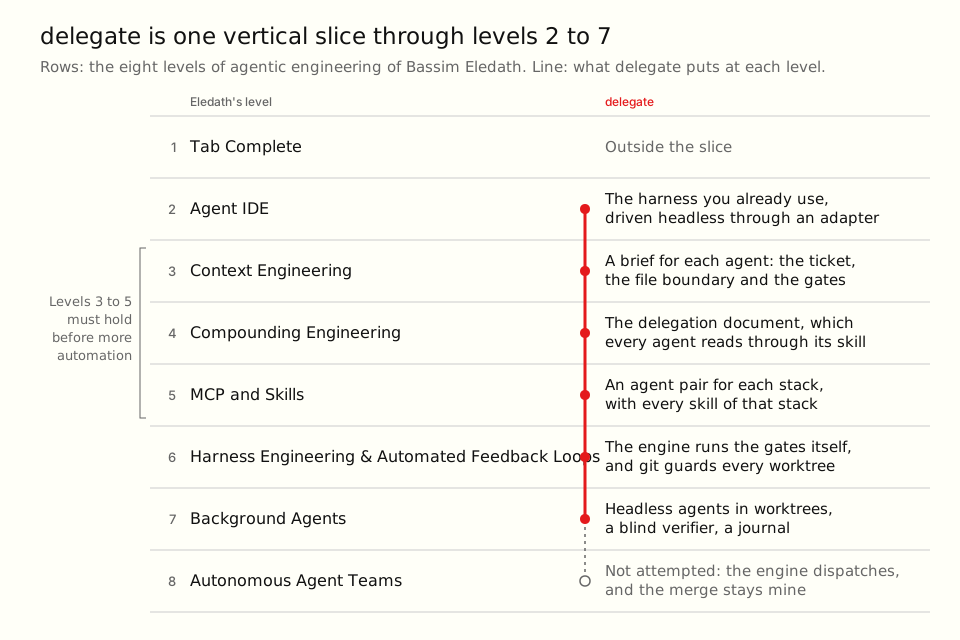
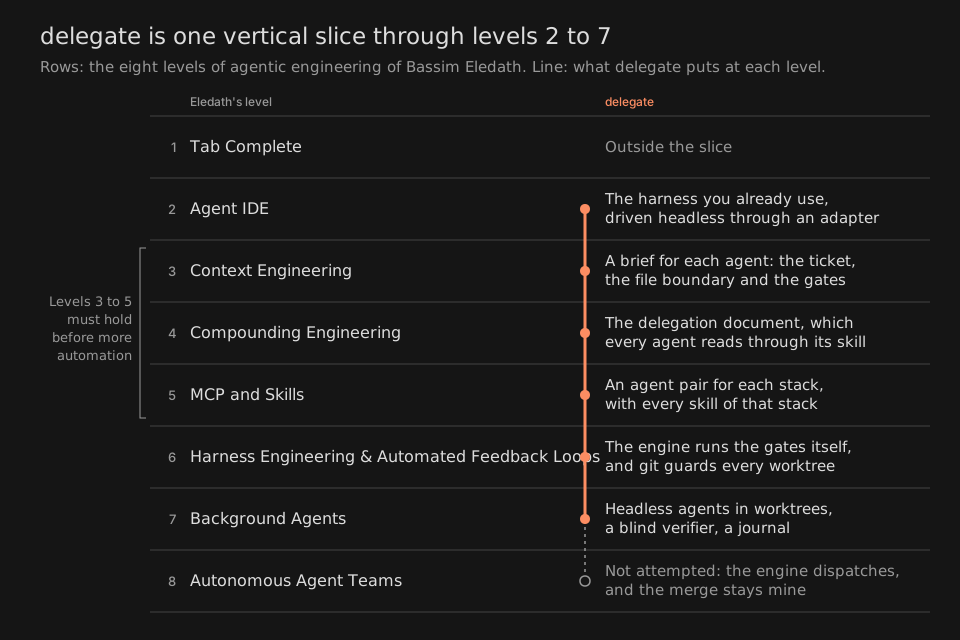
The same picture as a table:
| Level | Eledath's name | What delegate puts there |
|---|---|---|
| 1 | Tab Complete | Nothing. The slice starts at level 2. |
| 2 | Agent IDE | An existing harness, driven headless through an adapter. |
| 3 | Context Engineering | A brief for each agent: the ticket, the file boundary, and each gate to run. Nothing else. |
| 4 | Compounding Engineering | The delegation document, where each lesson becomes a rule, written down once. Each agent reads it live, through its context skill. |
| 5 | MCP and Skills | An agent pair for each stack, rendered from one declaration with every skill of the stack. |
| 6 | Harness Engineering & Automated Feedback Loops | The engine runs the gates itself and stops a diff that touches a hotspot. A push guard in git holds in every harness. |
| 7 | Background Agents | Headless agents in worktrees, a blind verifier, and a journal that a stopped run resumes from. |
| 8 | Autonomous Agent Teams | Not attempted. The agents never talk to each other: the engine dispatches, and the merge stays mine. |
Read the rows from the top, and Eledath's rule shows. The engine at levels 6 and 7 automates only what levels 3 to 5 make explicit: the brief, the written rules, and the skills of each stack. Take those away and the engine just runs the mess faster.
The mental model
The team
Somewhere along the way this stopped being about delegation. It became about team members who all follow the same rules and work the same way, whatever model runs them. The team has four members, and each one has one job.
- The coordinator is me, a person. I direct the work from a terminal or from an interactive session of a harness. I settle the decisions, write the tickets, pick the tiers and own the merge.
- The specialist is an agent that builds one ticket.
- The verifier is a second agent that checks the work of the specialist. It holds every skill of the specialist, the instructions for that kind of code, so it judges the work by the same standard. But it can only read.
- The engine is
delegate run: a program, not a model. It does the work that I don't trust a model to do: it writes the briefs, runs the gates, caps the fix-ups and keeps the record.
A specialist and its verifier are an agent pair, and a repository has one pair for each stack, each technology that it holds, such as a Python package or a web front end. One declaration writes both halves. It's the job description, and it's the same for every model that fills the seat.
The loop: Brief, Build, Verify, Merge
Four verbs name the loop, and every ticket goes through all four.
- Brief. I write a ticket, and list it in a workflow file. The engine turns the ticket into a brief, the prompt for one agent.
- Build. The specialist builds the ticket in its own worktree and commits. The engine then runs the gates itself.
- Verify. A blind verifier checks the work. Blind means it gets the ticket and the diff, and never the specialist's own account of the work.
- Merge. Accepted work lands on the run branch, a branch that the engine owns. I merge the run branch.
One ticket, from Brief to Merge
Here's one ticket through the loop: "The export command writes a header row."
- Brief. I put the ticket in a workflow, with the stack
python, the gatepython3 -m unittest, and the hotspotworkflow.toml, a path that only I change. I rundelegate run workflow.toml, which starts a run. The engine creates the run branchrun/demofrom my base branch,main. It makes a worktree with its own branch for the ticket, and sets a push guard in it, so no push leaves that worktree. Then it writes the brief: the ticket, the file boundary (the worktree, and the hotspots that the specialist must not touch), the gate, and the path where the specialist writes its report, its own account of the work. - Build. The specialist reads the brief, writes the header row and a test, commits, and writes its report: "committed, gates green". The engine does not take that word. It checks that the diff touches no hotspot, and then it runs
python3 -m unittestitself. If the gate were red, or the agent ran out of turns, the engine would send the specialist back to the same worktree for a continuation, and its commits would stay. Here the gate is green. - Verify. The engine rebases the branch onto the run branch. Here the run branch is still at
main, so the rebase keeps the commit, and the gate, green on that commit already, does not run again. A rebase that changes the commit runs the gate again. The engine makes a temporary copy of the branch, and gives the verifier a brief with two things in it: the ticket and the diff. Not the report. The verifier runs the gate in the copy. It breaks the code under the new test and watches the test go red, which is a red proof that the test can fail. Then it writes its verdict. This time the verdict is REJECT, with one finding: "The header row is missing when the data set is empty." - Build again. A REJECT starts a fix-up. The engine sends the finding, word for word, to the specialist in the same worktree. The specialist adds a new commit on top of the rejected one. It never amends. The engine runs the gate again.
- Verify again. A fresh verifier gets the finding and the delta, the diff since the rejected commit, and checks only that. Its verdict is ACCEPT. Had it rejected again, a second round would follow, and at the limit the ticket fails and the run branch stays where it was.
- Merge. On ACCEPT, the engine moves
run/demoforward to the commit that the verifier saw. Then it stops. It never merges intomain, never pushes, and never closes the ticket. I read the result withdelegate status, and I merge withgit merge --ff-only run/demo.
The same ticket, on one page:
---
config:
  sequence:
    mirrorActors: false
    actorFontSize: 15
    messageFontSize: 15
    noteFontSize: 15
---
sequenceDiagram
  participant Me as Coordinator (me)
  participant Engine
  participant Specialist
  participant Verifier as Blind verifier
  Note over Me,Verifier: Brief
  Me->>Engine: a ticket in a workflow
  Engine->>Engine: run branch, worktree, push guard
  Engine->>Specialist: the brief
  Note over Me,Verifier: Build
  Specialist->>Engine: code and test, a commit, a report
  Engine->>Engine: hotspot check, then it runs the gates itself
  opt the gates are red
    Engine->>Specialist: a continuation in the same worktree
  end
  Note over Me,Verifier: Verify
  Engine->>Engine: rebase, gates again on a new commit, temporary copy
  Engine->>Verifier: the ticket and the diff, never the report
  Verifier->>Engine: verdict
  loop REJECT, up to the limit
    Engine->>Specialist: fix-up: the findings
    Specialist->>Engine: a new commit, gates again
    Engine->>Verifier: a fresh verifier: the findings and the delta
    Verifier->>Engine: verdict
  end
  Note over Me,Verifier: Merge
  alt ACCEPT
    Engine->>Engine: the run branch moves forward
    Me->>Me: git merge --ff-only run/demo
  else REJECT at the limit
    Engine-->>Me: the ticket fails, and the run branch stays
  end
Look at where the evidence comes from. The gate result comes from the engine, not from the agent that wrote the code. The verdict comes from an agent that never saw the report. The merge comes from me. No arrow that carries evidence starts at the specialist.
Two dials: ability and assurance
I tune two things, and neither one touches the team contract.
The first dial is ability. A workflow names a tier, a strength, and never a model: strong, standard, cheap or verifier. The tier table maps each tier to a model for each harness, and a tier file can point the tiers at a gateway. A new model, or a new vendor, changes one file and no workflow. Turn this dial, and the code gets better or worse. The brief, the gates and the check stay the same.
The second dial is assurance. The mode trades cost against how soon I learn that something is wrong. assure is the mode of the example: it verifies each ticket at once, before the next ticket builds on it. economy builds a chain, where each ticket starts from the one before, and verifies once for each stack at the end. It costs the fewest tokens, and a defect shows late.
One dial sets how good the code is. The other sets how soon I find out that it is not.
Neither dial changes an invariant, one of the seven rules that hold in every mode. The verifier is blind. The engine runs the gates. Nothing reaches the run branch without an ACCEPT. And a cheaper mode never means a weaker verifier, because a cheap check is a false saving.
What the engine keeps
The engine records the run in the journal: one line for each event, appended and never rewritten. Gate results, verdicts, fix-ups and each move of the run branch are all in it.
I made it this way for three reasons. A run that stops, after Ctrl-C or a kill, can resume from the journal at the first ticket that is not complete, and it never builds a finished ticket again. So can a run that I stop overnight with a pause: it waits for the next step boundary, so it cuts off no agent. The resume can also carry a plan change: a new ticket, or a change to a ticket that has not started. The built part of the run stays as it is. delegate status and delegate watch read the journal, so I can see where a run is, and watch exits when the run needs me. And the journal is the record of the evidence: what ran, in which order, with which result. It's also the first place to look when a model falls short, because every REJECT and every fix-up round is in it.
What delegate is not
- Not a model router. It does not read a ticket and choose a model for it. A workflow names tiers, and the tier table maps each tier to a model. The choice stays with me, in one file.
- Not an agent swarm. The agents never talk to each other, and they never claim work from each other. That is level 8 of the ladder, and the kit does not attempt it. The engine dispatches, and I coordinate.
- Not a way to make a weak model strong. The contract and the checks are the same for every model, so a weak model fails where I can see it: red gates, REJECT verdicts, and fix-up rounds in the journal. The kit makes a weak model visibly weak. That tells me which tier to change.
- Not a coding agent, and not a harness. It writes no code. It drives an existing harness through its command line, and the agents in that harness write the code.
- Not an issue tracker. It reads each ticket, one unit of work written as behaviour, from a local file or from inline text. It never contacts a tracker and never closes a ticket. The tickets go to disk first.
- Not a CI system. It runs each gate of the repository (a command that proves a change is good, such as the test suite) on the local machine, to decide whether the work of one ticket can land. It never pushes, and it does not replace the checks that run after a push.
- Not a sandbox. An agent runs as the person who started it, with their permissions, in a worktree. If a policy needs a container, this kit is not enough by itself.
The parts of the kit
- The
agent-delegationskill holds the protocol: the roles, the brief template, blind verification, fix-ups and hotspots, in words that an agent reads. A person can follow it by hand for a single ticket. - The
agent-definitionsskill holds the rules of the renderer and the validator. One declaration renders an agent pair for each harness, and the validator checks the files against the schema of each harness. - The command bootstrap writes the declaration, the agent pair, and a context skill that reads the delegation document of the repository, the file with its gates, its hotspots and its rules.
- The brief generator builds every verifier brief from the ticket, the diff and the gates, and never from the report.
- The engine drives each harness through an adapter. Claude Code and OpenCode have one today.
- The tier table maps each tier to a model for each harness, so a workflow never names a model.
The two skills are in skills/, and the package that holds every command is in src/delegate/. The layout of the repository gives the place of each part and the direction of imports in the package.
Where to go next
- The tutorial runs the loop once, from install to one verified ticket. Start there.
- The how-to pages each solve one job: bootstrap a single-stack repository, bootstrap a monorepo, write a workflow for a run, run an economy chain, watch and resume a run, see the runs of more than one host, point the tiers at a gateway, add a harness adapter, and use the kit after
to-specandto-tickets. - The reference gives every field and every flag: the workflow file,
delegate run,delegate statusanddelegate watch,delegate runs, andrender,validate,bootstrap,briefandclean. - The explanation pages give the reasons: why the model should not matter, why the verifier is blind, why each specialist has its own verifier, the mode trade-off, the enforcement model and its limits, prior art, the concepts behind the words, why the code has this shape, and the decision records.
- The glossary holds every term, with the page that explains it in full.